
Menú principal
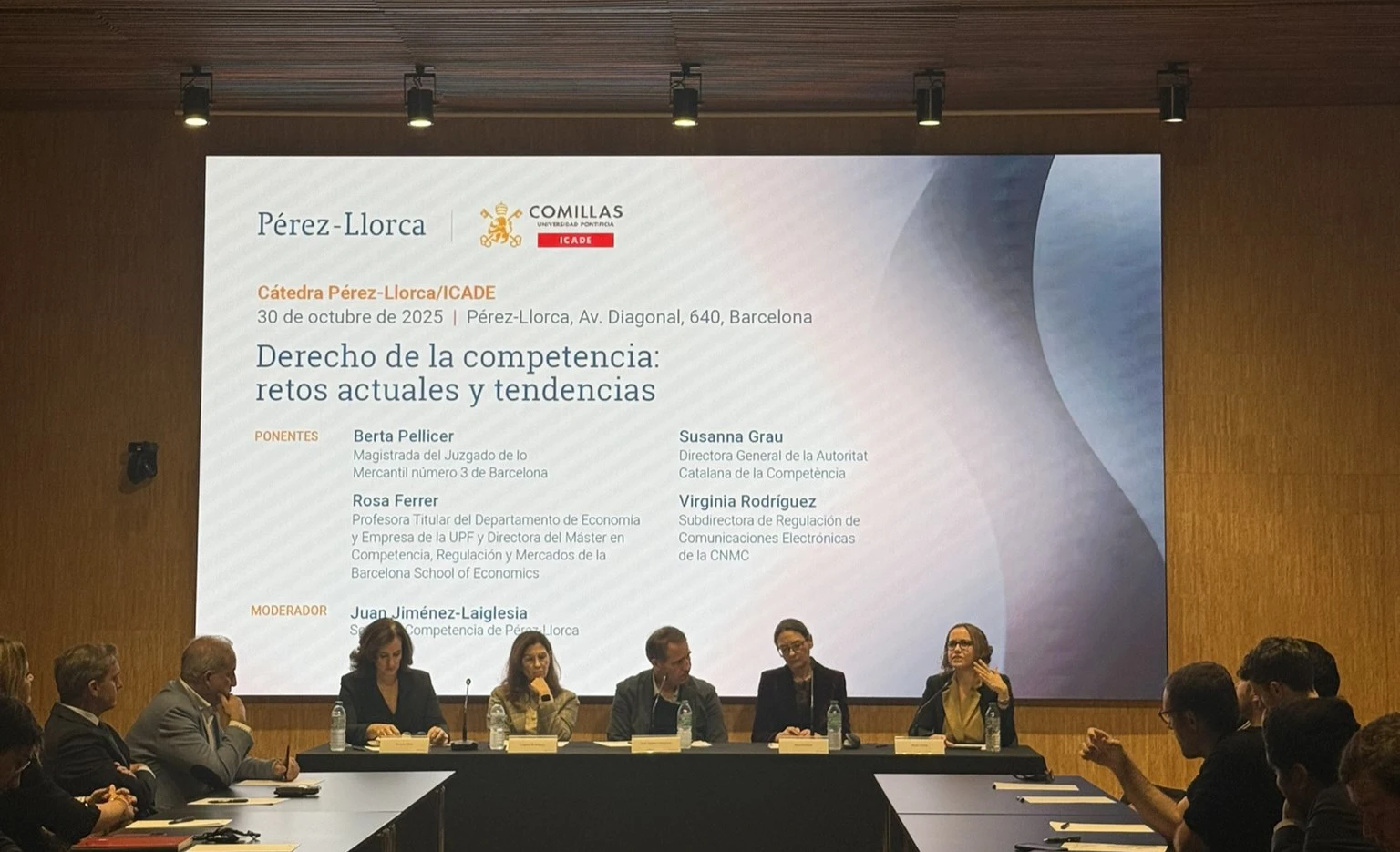
Pérez-Llorca and the Universidad Pontificia Comillas (Comillas ICADE) Faculty of Law held a new session of the Pérez-Llorca/ICADE Chair on Economics and Competition Law, dedicated to analysing the main challenges posed by the public and private application of competition law in the current European and Spanish context.
The event took place at the firm’s Barcelona offices and was attended by Juan Jiménez-Laiglesia, partner at Pérez-Llorca; Rosa Ferrer, lecturer in the Department of Economics and Business at the Universitat Pompeu Fabra and director of the Master’s Degree in Competition, Regulation and Markets at the Barcelona School of Economics; Virginia Rodríguez, deputy director of Electronic Communications Regulation at the National Commission on Markets and Competition (CNMC); Berta Pellicer, judge of Barcelona Commercial Court No. 3; and Susanna Grau, director general of the Catalan Competition Authority (ACCO).
Juan Jiménez-Laiglesia opened the seminar by highlighting the significance of the current situation in the field of both merger control and damage claims. He underlined the importance of the revision of the European Commission’s Guidelines on the assessment of horizontal mergers, as well as those on non-horizontal mergers, and the impact they will have on merger control practice in the coming years. In his speech, he pointed out that “public and private enforcement of competition law are bound to converge, because both pursue the same goal: to ensure more transparent, efficient and fairer markets.”
Rosa Ferrer went on to analyse the interactions between law and economics in merger control, stressing the need for an approach using quantitative tools to measure the impact of mergers on consumer welfare. She emphasised that “mergers have to be assessed in terms of how they affect prices, quantity produced, quality and innovation”, adding that “measuring the latter two factors is challenging because they are particularly complex to quantify and predict. That’s why there is currently a debate in Europe on competition and industrial policy.” In this regard, she argued for the importance of improving the availability and quality of data in order to design policies that promote innovation and effective competition.
Next, Virginia Rodríguez focused her speech on the current situation of the telecommunications sector from a regulatory perspective. She explained that the CNMC exercises, among others, ex ante regulatory functions over operators with significant market power, imposing obligations of access, transparency and non-discrimination with the aim of preventing anti-competitive behaviour. Rodríguez stressed that Spain has one of the highest levels of high-capacity network coverage in Europe, although she warned that the European market is very disparate and progress is needed to achieve the EU’s digital transformation objectives. She also pointed out that the reforms under preparation at European level aim to “advance the construction of the internal market, harmonise rules, simplify procedures and strengthen Europe’s digital sovereignty,” and stressed “the need to adapt regulation in the face of technological convergence, ensuring balanced competition in a rapidly changing environment.” The deputy director referred to other regulatory measures that are essential for the rollout and whose compliance is monitored by the CNMC, such as the Gigabit Infrastructure Act, which has been applicable since November this year.
Pellicer also analysed the evolution of case law on damages actions for infringements of competition law, paying special attention to the recent decisions of the Court of Justice of the European Union and the Spanish Supreme Court. She stressed that “the Spanish Supreme Court has consolidated case law in favour of full compensation, reinforcing the binding effect of the competition authority’s final decisions not only to prove the infringement, but also to presume and estimate the damage.” The judge explained that the finality of the decisions and the calculation of the limitation period are currently two of the most decisive aspects in these types of proceedings. Furthermore, she stressed the importance of maintaining a balance between legal certainty and the effective right to relief.
Lastly, Susanna Grau addressed the connection between public and private enforcement of competition law and defended the claim for damages as an essential tool to reinforce the culture of compliance and the effectiveness of the system. The ACCO’s director general stressed that “the damages market has expanded beyond large corporations, also incorporating claims from SMEs, individuals and even the public sector,” and highlighted the initiatives promoted by the Generalitat de Catalunya to “institutionalise a policy of zero tolerance towards infringements and promote the systematic recovery of damages suffered by public administrations.”
To conclude the session, the speakers discussed issues such as the proliferation of preventive complaints in tenders and the calculation of the limitation period in different scenarios. In closing, Juan Jiménez-Laiglesia stressed that “cooperation between authorities, courts, economists and lawyers is essential to face the new challenges of competition law in Europe” and added that the Pérez-Llorca/ICADE Chair will continue to be a meeting point to promote this dialogue and anticipate the transformations that will mark the future of this discipline.