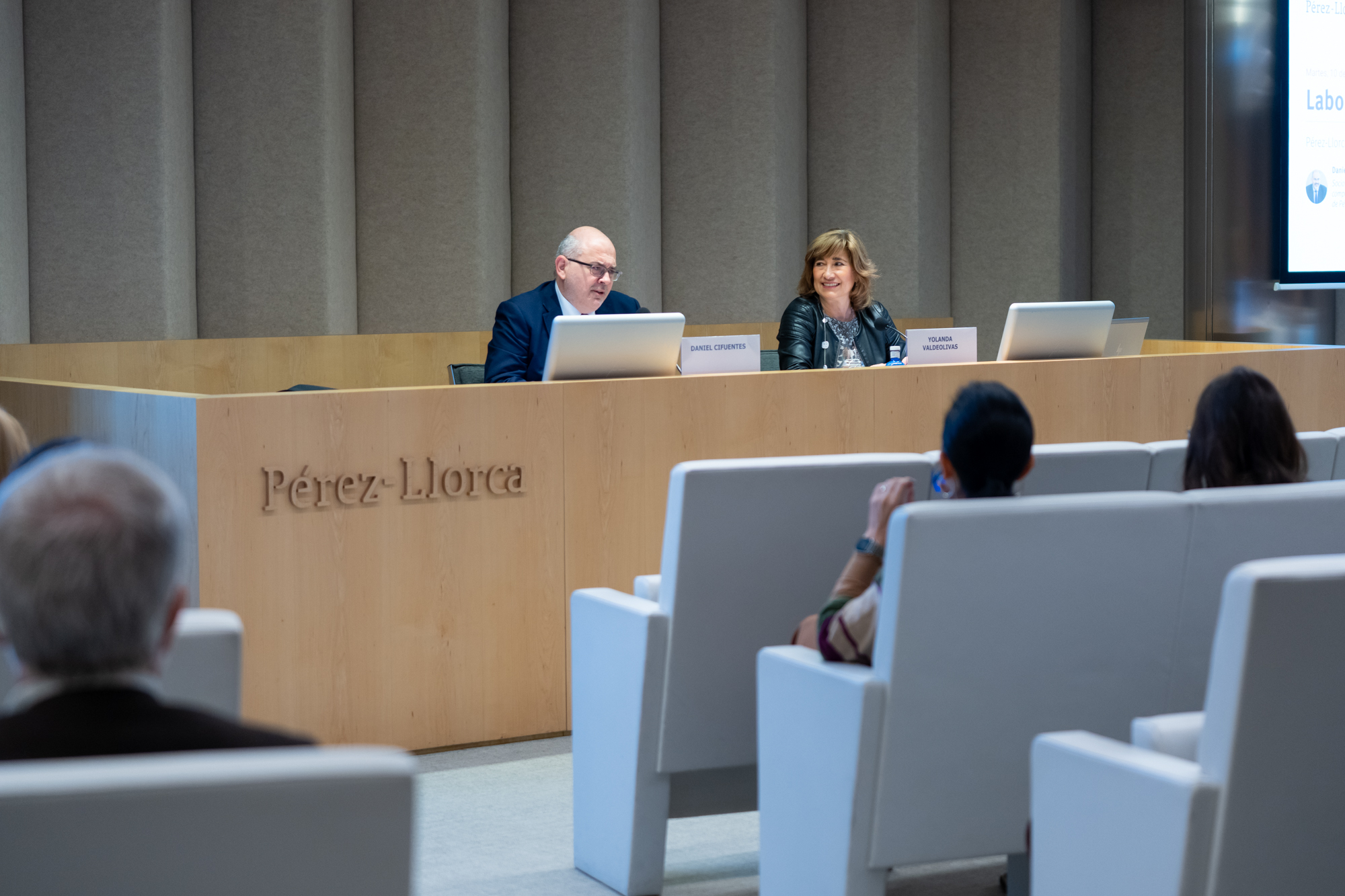
The event was led by Daniel Cifuentes and Yolanda Valdeolivas, partner and Of Counsel of this practice area, respectively, who offered a comprehensive overview of the most significant rulings handed down by the main national and international courts over the past few months.
Daniel Cifuentes opened the seminar by highlighting absenteeism as one of the main challenges facing companies today, due to its high rates. The Pérez-Llorca partner noted that “absenteeism has become one of the biggest concerns for companies, not only because of its economic impact, but also because of its organisational and people management implications.” He also announced that the government will set up the Temporary Incapacity Observatory, as a measure aimed at analysing and alleviating this problem.
On the subject of collective bargaining, Cifuentes analysed the recent proposals from CCOO and UGT, the main Spanish trade unions, on the 6th Agreement for Employment and Collective Bargaining, while Yolanda Valdeolivas went on to discuss their main novelties and possible practical impact. At this point, the speakers preliminarily introduced the issue of gender pay equity, which was expanded upon later on in the session.
The event also addressed new trends in whistleblower protection, highlighting the creation of a specific channel on the Independent Authority’s website for receiving disclosures and the challenges that its implementation will pose for companies.
With regard to the outlook for the labour market, the speakers made reference to both the International Labour Organisation’s annual report on artificial intelligence and the survey published by the Spanish Chamber of Commerce, highlighting the technological and organisational transformation that companies are undergoing. In this context, Valdeolivas noted that “the increase in contributions approved for 2026 and the strengthening of certain administrative obligations create a more demanding scenario for companies.”
In the event’s second section, dedicated to the case law chronicle, the speakers carried out an exhaustive review of the most significant decisions handed down by the Constitutional Court, the Court of Justice of the European Union, the Spanish Supreme Court and the Spanish High Court during the months of October, November, December and January. They analysed rulings made on a number of matters, including employer contributions to the Public Treasury, temporary disability supplements, work-life balance, changing collective agreements, substantial modifications to working conditions, parental leave under Article 48 bis of the Workers’ Statute, freedom of association, privacy of salary data and various issues related to working time.
Then, following the usual ‘Pérez-Llorca Labour Law Update’ session format, Cifuentes and Valdeolivas presented the top three most significant judgments from recent months. This time, first place went to judgments on absenteeism and its impact on salary, highlighting the Supreme Court rulings of 14 and 16 January 2026, which consider it discriminatory to exclude periods of Temporary Incapacity from the accrual of attendance bonuses or variable remuneration, as opposed to rulings from the Spanish High Court, such as the one handed down on 6 October 2025, which endorse the proportional apportionment of incentives when the absence is not unduly penalised.
In the final part of the session, the speakers addressed the key aspects of Directive 2023/970, which strengthens pay transparency obligations. As Valdeolivas explained, this regulation does not replace the existing regime in Spain, but rather adds new obligations aimed at strengthening the culture of transparency. In this respect, the firm’s Of Counsel noted that “the Directive introduces a paradigm shift by extending the right to information, which no longer focuses exclusively on the legal representation of workers but also extends to individual workers.” She also warned that, given the specificity of its mandates, certain provisions could be susceptible to direct application if not correctly transposed by 7 June 2026.