
Menú principal
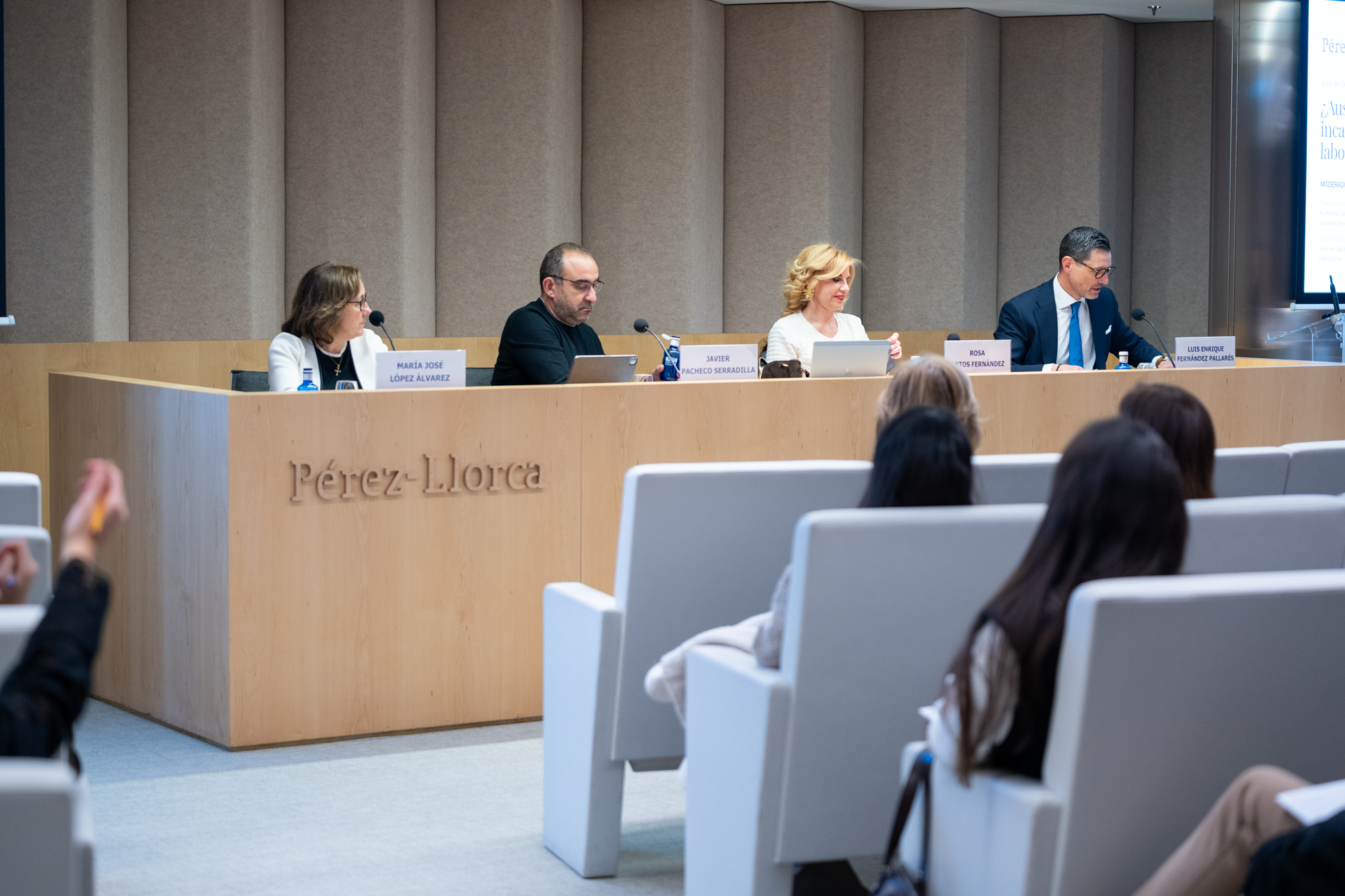
The session was moderated by Luis Enrique Fernández Pallarés, partner in Pérez-Llorca’s Employment, Compensation and Benefits practice area, and María José López Álvarez, lecturer in Labour Law and Social Security at Comillas ICADE. Guest speakers were Rosa Santos Fernández, director of the Spanish Confederation of Business Organisations (CEOE)’s Employment, Diversity and Social Protection Department, and Javier Pacheco Serradilla, the Workers’ Commissions (CCOO)’s secretary of Trade Union Action and Strategic Transitions.
During the opening of the event, Luis Enrique Fernández Pallarés highlighted the significance of absenteeism linked to temporary incapacity, underlining that “it has become one of the main structural challenges of the Spanish labour market, both because of its quantitative dimension and its impact on the organisation of work and the sustainability of the system.” In this regard, he emphasised the need to approach the debate in a technical and rigorous manner, enabling the causes of the increase in temporary incapacity proceedings to be accurately identified and balanced solutions to be found.
María José López Álvarez went on to give an overview of the current state of temporary incapacity, providing data to contextualise the magnitude of the phenomenon, especially after the COVID-19 pandemic. For López Álvarez, “the analysis of absenteeism requires a proper differentiation between situations of legitimate health protection and possible dysfunctions in the management of the system”, putting forward as a first issue the causes that have led to the increase in temporary incapacity processes in recent years.
Similarly, Javier Pacheco pointed to a number of concurrent factors, including the employment cycle itself, the general deterioration of health observed in the population, the transformation of employment relationships derived from the arrival of new technologies and the National Health System’s lack of resources. “The phenomenon cannot be explained from a single cause, but rather as the result of structural changes in employment, health and work organisation,” said Pacheco.
Rosa Santos then spoke, and after noting that “Spain is a world leader in temporary incapacity due to common contingencies”, she pointed out that “the shortage of health professionals, the lack of coordination between administrations and the weakness of control mechanisms are the main causes to which, as an accelerator, the complements of the agreements to the benefits may be contributing.” According to her, “we are facing a phenomenon that compromises the health of working people and is having a direct impact on the productivity and competitiveness of companies while increasing the financial pressure on the National Institute of Social Security.” Rosa Santos put the Temporary Incapacity due to Common Contingencies bill, which is paid equally by the INSS and Spanish companies, at €33 billion.
In the final part of the debate, the moderators invited the speakers to make concrete proposals aimed at mitigating the current situation, insisting that “the scale of the problem calls for solutions that combine more efficient management of processes with full respect for the rights of workers.” Among the measures proposed, Pacheco highlighted the need to develop the 5th Agreement for Employment and Collective Bargaining, promoting the role of mutual insurance companies in traumatological processes, strengthening coordination between the workplace and health surveillance, and greater investment in health resources and prevention. For his part, Santos agreed on the need to strengthen the health system’s resources and coordination, and proposed, among other things, bringing forward the monitoring of sick leave from the start of the process, particularly in cases of repeated sick leave due to various pathologies, with the collaboration of the mutual insurance companies if deemed necessary.